Tuesday, September 10, 2013

Atlanta Open


Last weekend, Triangle Jiu Jitsu and several other Royce Gracie schools competed in the Atlanta open. This is the closest that the IBJJF comes to North Carolina, so it was a big deal to us. We showed up in big numbers and did some serious work.

I was happy to win double gold and was thrilled that my teammates Seth Shamp, Jeff Shaw, and Chela Tu won gold medals as well. Overall, Team Royce Gracie took home too many medals to count!


What I liked about the tournament:

- As the only IBJJF tournament of drivable distance, it attracted NC Royce Gracie folks in record numbers.

- I was not only representing myself and my school, but I was representing the larger Royce Gracie network. People who normally compete against each other in local tournaments came together to form 1 Royce Gracie unified team. It was a nice feeling to be part of a group much larger than myself.

- Brackets ran on or ahead of schedule. There was no excessive waiting around.

- Even when competing with folks with whom I've grappled before, the intensity was higher than it is at local tournaments. We all put in training camps and drove a long way for this, so the stakes were elevated.

What I didn't like about the tournament:

- The venue made viewing matches difficult. One of the best things about going to IBJJF tournaments is watching the elite upper belts compete. At this venue there was no stadium seating, so I had to fight to get mat side to watch my teammates roll. Getting to a vantage point for any of the black belts was a non-probability.

- I almost didn't get to compete in the absolute division. I've done a handful of IBJJF tournaments and have heard my share of horror stories of people getting screwed by ring coordinators. Some people have traveled as far as the mundials in California, only to be mysteriously dropped from their brackets without a chance to compete. As restitution, they get offered free entry into next year's tournament, which is a pathetically inadequate reimbursement. After investing time in training camp and money in a tournament entry fee, plane ticket, and a hotel stay, free entry into next year's tournament is a paltry consolation for getting dropped from a bracket this year.

Knowing what could go wrong, I was the very first out of all of the adult blue belts to register for the absolute division.  I very clearly stated my name, rank, and division, and did not leave until it was verified that I was registered. I then went about my business cheering for my teammates. However, when the time came for my absolute division to compete, my name was never called. I was not on the list. The ring coordinator actually tried to convince me that I hadn't registered. As if! After some wrangling, I finally managed to get my name back on the list where it belonged. Whew!


Tuesday, September 3, 2013

Freedom, feminism, and racy photos – the controversy surrounding sexy grapplers

I feel fortunate to live in a culture that values freedom of expression as a basic human right. Individuals can express themselves openly and freely through speech, writing, art, movement...you name it.

The personal freedom that enables me to write this blog also empowers me and other women to dress the way we please, whether we choose to wear a burka or a thong. Some people choose to dress conservatively in public and some people choose to dress provocatively. Some people choose to express their sexuality through their outward appearance. Those who do so are not asking to be harassed, groped, raped, or otherwise creeped on. Harassment, of course, is the fault of the harasser alone and not the victim.


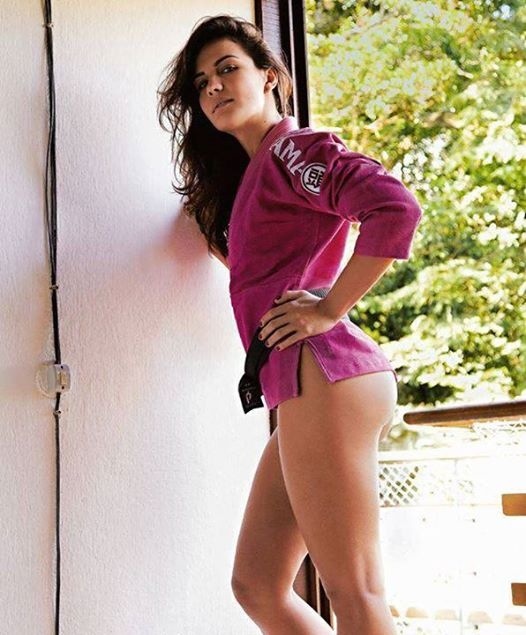
Provocative photos are abundant on the internet. Among them are the widely circulated photos of jiu jitsu and MMA women posing in sexualized ways, including this recent photo of Kyra Gracie:


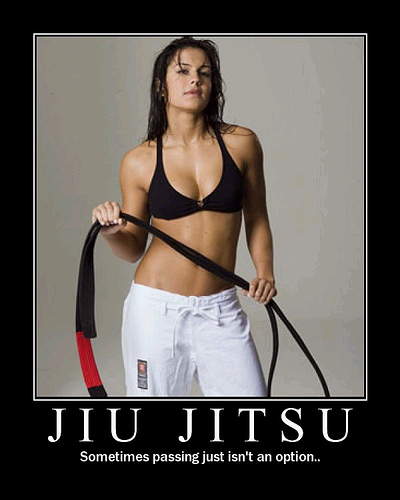
This is just the latest example of sexualized photos of grappling women on the mats or in gis. Here are a few others: 


While the first photo has been getting a lot of recent attention, images like that one are nothing new. These photos are all over the internet and social media, and unless you're living with the Amish, you really can't escape them.
 
Certainly, it is a woman's right to pose however she wants for photos. That means she can pose provocatively if she so chooses. Some jiu jitsu women may even benefit professionally and financially from the media exposure that comes from these sexy photos. No laws are being broken by these images and no one is being directly hurt by them. So what's the big deal?

While these photos may seem harmless to outsiders, jiu jitsu women have another opinion. While I cannot speak for everyone, the general reaction to these images from women in my training circle has been negative. I share that sentiment. We are not denying the rights of women to dress and pose as they please. Nor are we blaming the women for the creepy and obnoxious posts that some men are making in response to these images. But the general consensus from the women I have spoken to is that female martial artists do not like being represented this way. We understand that sex sells and that having a sexy image can increase one's marketability. We understand that posing provocatively can gain exposure for an athlete beyond what one might earn through athletic accomplishments alone. Yet, images like these undermine the culture that many jiu jitsu women are trying to foster.

Women work hard to earn respect on the mats and to be taken seriously as training partners. Jiu jitsu may be an intimate sport, but the mats are the last place that we should worry about being sexualized, especially since many women come to jiu jitsu in the first place to learn self-defense. We deserve the same security while rolling that men take for granted - knowing that if we throw up a triangle, that our partner's mind is 100% "I better defend this or I'll get choked unconscious" and 0% "This is hot."

Julie Johansen wrote a blog BJJ and Gender: Group Responsibility vs Individual Freedom, which examines our right to act as individuals vs. our responsibility to positively represent the groups that we belong to. We all have the right to make our own choices and to express ourselves the way we please. But whether we like it or not, our actions can affect not only our own images, but the images of the groups that we belong to, especially when we belong to a minority group. This got me thinking about social psychology.
 
Humans naturally sort items into groups, in order to find patterns and better make sense of our environment. The way we sort people is called social categorization. We  naturally classify each other on the basis of sex, race, age, occupation, and various other attributes. This process is adaptive because by discovering patterns, we are able to think and act more efficiently, freeing our cognitive resources for other tasks. On the downside, it can lead to harmful stereotyping,
 
Groups that we belong to - our own gender, nationality, religion, etc - are known as our ingroups. Groups that we do not belong to are outgroups. The process of outgroup homogeneity is the process by which we naturally assume that members of outgroups are more similar to each other than members of our ingroups are. The racist cliché "people of X ethnicity all look the same" is an example of this. Members of the majority class are easily able to find differences among members of their own group, while they automatically lump members of other groups together.
 
This process extends to attributes beyond race. A while back, a student from another martial arts school tried a class at my school and behaved like a jackass. When that school was later brought up in conversation, I said "Those guys are assholes." I immediately caught myself. I had met one guy from that school and he behaved like an asshole. It was unfair to extend this trait to other members of that group. Yet, that was what I had naturally done. The error in thinking was mine, but this individual's bad behavior  had reflected negatively on the image of his entire school. 
 
As a minority group in jiu jitsu, women are the outgroup to most jiu jitu practitioners. Consequently, as diverse as we may be, we get lumped together at least subconsciously. 
 
When people look at the sexy poses pictured above, it is fair to assume "these women want to be noticed sexually." Not raped, molested, or harassed...but it is fair to say that they want to be noticed in a sexual way. However, it is wrong and harmful to assume that "jiu jitsu women" want to be noticed in this same way. Most, in my experience, do not want that on the mats. We want to be noticed instead for our hard work, toughness, cooperation, and general ability to kick ass. Which is why we grumble about these photos.


Sunday, September 1, 2013

Jiu jitsu and pregnancy

Gotcha! No, I am not expecting. But Cynthia Davis, a badass purple belt from Morrisville Tenessee, IS. And she has been nice enough to share her experiences with us regarding jiu jitsu training and pregnancy.


Congratulations! Is this your first child? How far along are you?
Yes, this is our first child. I am currently 34 weeks along.    

How has your training changed since becoming pregnant? Are you still rolling? If not, when did you stop?
Training changed a lot. I was injured before becoming pregnant so was only working my top game, once my husband and I found out I was pregnant we decided that I should stop training during the first trimester. I would drill lightly with him but no one else. I started back to training during the second trimester with extreme restrictions...no rolling/sparring and I did modified floor movements, drills, and takedowns. I only did these with my husband and would spend part of class showing others how to do moves or answering any questions they had about a particular move. Once the third trimester hit we both decided that I should not do drills or anything else as my balance was getting questionable..we realized this when I was attempting to stand up in base and had a hard time of it.

I imagine certain techniques are more difficult to execute while pregnant. Is anything particularly tricky or funny to perform? Is there anything that you suddenly got better at? 
The guys laughed really hard at my shrimps and bridges. Knee on belly was a blast and any side control position was great..mainly because I had gained weight and it made me heavier. I loved it!


How did you tell your training partners that you were pregnant? Did people start treating you differently?
Once the safe period was over (risk of losing the baby) I started telling people. Everyone at the gym was/is excited. I was treated differently..they would watch to make sure I wasn't going to do anything to hurt myself. They also made me the mascot! lol

After the baby comes, how long do you expect it will be before you can resume training? Will you compete?
Once the baby gets here I will start training as soon as my doctor gives me clearance to. Eventually I would like to compete again.

You will be able to say that your baby has been on the mats since before he or she was born! Do you think that you have a future champion in the making?
I like to think we have a future champ in the making! I plan on working with her as soon as possible so it will be second nature to her.

Obviously, expecting fathers don’t experience the same physical changes that expecting mothers do. Be honest – does it bother you that your husband gets to keep training without physical limitations?
I am so jealous that my husband gets to train! I am happy that he can but I miss being out there training with the guys. I still coach them during class but it just isn't the same!

If you were going to name your child a badass jiu jistu name, what would it be?
Hmmm I am not sure what name it would be, but as much as she balls up it would most likely be a jiu jitsu position like turtle or Neto (Neto roll). 

Do you have any advice for other pregnant jiu jitsu women who want to keep training?
No two women have the same pregnancy and it boils down to doing what you and your partner are most comfortable with. My doctor said I could train throughout my pregnancy because my body was used it, but no stupid moves. I still decided not to train as much as I could have because if something happened to the baby as a result of what I was doing at gym I never would have forgiven myself. So my husband and I erred on the side of caution. If I felt winded, warm, thirsty..I sat out. If a move feels odd because the belly is in the way either modify the move or don't do it.


Thanks, Cynthia! 

Friday, July 26, 2013

Keeping it playful vs. keeping it real

Flip Ryron Gracie's coin before your next roll, and you get 1 of 2 outcomes:

1. Keep it playful
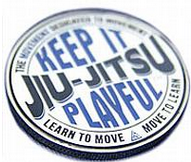
KeepItPlayful Coin  

"When the coin lands on the KeepItPlayful side," Ryron writes in his blog KeepItPlayful,  "we play jiu-jitsu, we allow movement at all costs because that is how we learn. We take submissions and we give submissions. We acknowledge that the need to be in control and be victorious is important but just as important is learning to relax and building comfort in all positions."

The other option is:

2. Keep it real

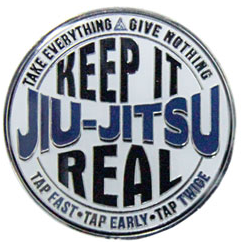
KeepItReal
"When the Coin lands on the KeepItReal side, we allow that which is real to surface. Although safety for our training partner is #1 we must still do them a service and control positions to the best of your ability and when we see an opportunity we take the submission and do not leave any space for escape."


And it got me thinking - What do I do most? And  what do I prefer? And most importantly, which is most beneficial - keeping it playful or keeping it real?


Out of  my regular training partners, I think I am able to keep it on the playful side about 75% of the time. I'm not flowy the way that Ryron describes, but there is room for joking, encouragement, and playfulness with most of my rolls. This is especially true if my partner is significantly more or less skilled than I am -  that takes part of the ego out of it. When rolling with someone better than me, whom I suspect is not going at 100%, I am able to focus on movement and techniques. I defend submissions with 70%-80% effort, but tap quickly when needed and do not risk going to sleep or straining a joint. After all, I know my partner could tap me again pretty quickly if desired. I try to survive and escape, but if I can't it's no big deal. On the other hand, if I am more skilled than my partner, it is also easy to keep it playful (unless they are much bigger or stronger and are trying to beast me). I look for submissions and attack them with moderate effort. If my partner defends, I benefit more from moving on and chaining my attacks then by doing mean and nasty things to break through their defenses.

I would describe most of my rolling as hard but playful - the best of both worlds. I prefer to roll this way, most of the time. But there are some folks with whom I keep it real on the regular. Truth be told, I can like these rolls just as much. During evenly matched rolls, we may start out flowy  but the intensity can escalate quickly. It is not that we are trying to kill each other - I don't roll with people who make me feel unsafe - but we are so closely matched that our intensity picks up naturally.

I also keep it real with brand new folks who, often through no fault of their own, do actually try to kill me. If someone spazzes at me with full throttle, I'm not going to relax and flow with them. Or if they brag about passing my guard, obtaining a dominant position, or even not getting tapped by me,  I am going to up the ante during our next roll.

In my opinion there is an important place for both types of rolling. Keeping it playful  helps me practice what I am working on, defend and execute chains of attacks, and keeps rolling fun. Keeping it real tests the effectiveness of my jiu jitsu and shows me what I need to work on.

Which do you prefer? Do you like to keep it real while you roll or do you prefer to keep it playful?


Wednesday, July 17, 2013

Open door jiu jitsu


One of my favorite things about jiu jitsu is its open door nature. Basically, if you are a non-douche bag and a dues paying member to one jiu jitsu school, then other schools will let you drop in on their classes and open mats  - quite often for free.

Since I work on a school calendar and have extra time to train over the summer, I have been taking advantage of this quite a bit. And I'm starting to realize how fortunate I am.

- I am lucky to be welcomed at other schools when I am able to drop in and train.
- I am lucky that students from other places frequently drop into my school, giving me the opportunity to train with new and different people.
- I am lucky that when my instructor goes out of town, highly qualified instructors from nearby schools step in to teach classes.
- I am lucky to be a part of jiu jitsu networks that coordinate large, diverse open mats, where I have the opportunity to train with everybody.

I am fortunate that while I pay dues only to my own school,  I am able to learn from instructors and students from other schools on a regular basis. In my experience, this generous open door policy just doesn't exist with other sports. If I have to work late one week and miss my Crossfit workouts, for example, I would not expect to be able to drop into another box and be able to train there that week for free. Likewise, in  my swimming days, if my masters swim coach went on vacation for the week, I would not have expected a coach from another team to volunteer to take over our workouts. This just doesn't happen...but it does in jiu jitsu.

If you train at a really awesome jiu jitsu school like I do, you will experience an open door policy on another level... with other martial arts. In its purest form, jiu jitsu is a self defense system that evolves over time, incorporating or countering aspects from other martial arts. One of my training partners trains Taekwondo. Others have backgrounds in boxing, muay thai, or wrestling. I am terribly inconsistent, but at times I cross train in Judo. Training in these other arts does not conflict with jiu jitsu, but rather makes us more complete martial artists and ultimately enhances our abilities to survive a street confrontation.

So, yes, one of the things I like most about jiu jitsu is its utter non-jealousy. I am not only allowed to train with other people but am actually encouraged to do so. I am lucky to have access to so many places and people who make me better.


Sunday, July 14, 2013

How not to stink at jiu jitsu


No, I am not going to talk about how to get good at jiu jitsu. If you figure that one out, please let me know. What I am talking about here is how not to stink - as in, how not to emit foul odors on the mats.

There are blogs that should never have to be written and this may be one of them. But then again. you are bound to roll with folks who just plain stink. It is beyond gross. In a sport where we are in constant close contact, exercising good hygiene not only makes rolling more pleasant, but also protects the health and safety of your training partners.

So how do you keep from stinking at jiu jitsu? Just follow these easy steps:

  • Wear deodorant every time you roll. If you feel that you are particularly sweaty/stinky (and if you have any doubt assume that you are) apply a fresh layer before training. 
  • Wash your gi every time you wear it. There is no way around this. Hanging your gi up to dry is insufficient. It needs to be washed. every.time. Spraying your gi  with Febreze covers the smell for about 30 sec and does nothing to kill the cooties.
  • Know when to vinegar soak or just plain bail on your clothing. Sometimes, when you have sweat through something enough times, a simple washing will no longer do. Sometimes clothing becomes so saturated with funk that as soon as you begin to sweat in it again, it starts to reek. A good vinegar soak might save some items, but some are beyond salvation. Know when to let go.
  • Do not smoke in your gi/training clothes. Smoke clings to the fabric and you will become stinky to your nonsmoking friends, who likely do not want the 3rd hand smoke exposure either.
  • Just say no to perfume and cologne.  It is important to note the following: 1) perfume/cologne smells stronger to those around you than it does to you and 2) body heat enhances its strength. So as you are sweating, your fragrance can actually get more powerful. What smells nice to you can be overpowering to your training partners, especially as it interacts with other delicious mat smells.
  • Take showers after training, washing everything including your hair. Yes, guys need to wash their hair too. Head and Shoulders or any other kind of manpoo is adequate and will get the job done. If you want to go the extra mile, I have a few training partners who I suspect use their wives' shampoos. Their hair not only does not stink, but actually smells fruity and pleasant. 
  •  Keep your breath fresh. I am a heavy coffee drinker and a lover of all things spicy and garlicky. I also work with school children who do not hesitate to let me know when my breath stinks. My solution? I keep mouthwash in my car. I rinse my mouth every time before I train. This rule holds true for smokers as well. 
  • Easy on the bean burritos. My favorite food in the whole wide world is queso. If I could eat only 1 thing for the rest of my life (with nutrition not being a concern) that would probably be it. But truth be told, queso leaves me farty. Not the odorless, "just noise" farts that come from being stuck in knee on belly, but the kind of farts you would expect from eating a massive amount of processed cheese product. Yes, my husband is a lucky man. But needless to say, I would never eat queso before training. And whatever your queso is, you need to avoid it before rolling too.  
So in a sport where we get smooshed underneath each other, swap sweat, and get hair in our faces, the very least we can do is not stink. The funk is not your secret weapon. The funk is disrespectful and potentially dangerous to your teammates.

Look at it this way: The better you smell, the more people will want to roll with you. The more people want to roll with you, the better you will get at jiu jitsu.

Thursday, July 11, 2013

Male althetes' biggest opponents are their own balls

"You can only hope to contain them."


Amanda Hess' article  Female athletes' biggest opponents are their own breasts on ESPN.com accurately describes what a handicap boobs can be in virtually all sports. And I have to agree. Both in my life as a swimmer and now as a martial artist, I can attest that there certainly are times when boobs are a pain. They get in the way, don't stay put, get banged and bruised, or try to make appearances when they shouldn't. Despite its patronizing title, I thought this article gave a fair overview of a universal nuisance for female athletes. 

But, while the article was written by a female, is was also written from a male norm perspective. As in, male athletes are the norm and female athletes are the exception, or the deviation from that norm. Female athletes are handicapped to varying degrees because they have breasts of varying sizes. Breasts are portrayed not as normal body parts but as something to be fought and ultimately overcome in a female's quest for athleticism. Breasts are cited as our biggest opponents. The author argues that "a mounting body of evidence suggests that they pose a serious challenge in nearly all corners of competition."

The more I think and stew about it, the less I like this article. Women may be inconvenienced by our boobs, but at least our gonads are tucked away internally where they can safely reside. Men have no such luck - theirs are all out there in the open, where they are vulnerable to all sorts of assaults. It makes me think that this might not really be a female problem. Perhaps it is male athletes whose biggest opponents are  their own balls. 


Let's break down the specifics of the article:

  • Women Men are handicapped because their breasts balls can slip out of clothing, causing embarrassment. Ronda Rousey, whose boob almost slipped out of her bra during her first UFC fight, is cited as an example. However, Dennis Hallman's testicle actually did become exposed during UFC 133. Further, I come from a competitive swimming background, where swimsuits are chosen for speed, not for appearance. Male swimmers, as a whole, are fairly modest about their balls and strongly prefer to keep them covered in public venues. Speed suits do not make modesty a priority and the ensuing overexposure can be a source of embarrassment for male athletes.
  • Women Men are handicapped because their breasts balls get in the way of executing athletic movements.  Breasts might influence how a female athlete swings a golf club, sure. But that doesn't compare to what guys go through on a spin bike. Those seats are brutal and there seems to be no way to rearrange to comfortably adjust. Male athletes' only hope is to gradually numb the area over time. I have a friend who will not ride a bike at all, citing fertility concerns. 
  • Women Men are handicapped because their breasts balls add extra weight to their frames.  Testicles add about a half of a pound to the bodies of male athletes. And every pound of body weight counts in sports like running and gymnastics. 
  • Women Men are handicapped because breasts balls bounce during athletic activities, causing pain and discomfort. "Research has confirmed that size does matter: As breasts balls get bigger, they accelerate quicker, move faster and bounce higher."
I'm surprised that this one was not mentioned in the article:
  • Women Men are handicapped because when breasts balls get hit, it hurts like a motha.
    When I get hit in the boobs, it hurts a decent amount, but it is not terrible. I'd rather get hit hard in the boobs than the stomach, for example. Unless I am being lied to, getting hit in the balls brings pain to a much higher degree. My training partner tells me that he would much rather get hit in the stomach than in the balls. Unfortunately, when you do contact sports, getting hit in the crotch is a fact of life. And if the ref doesn't see it, the fight/match/game goes on.

The author goes on to describe how women are more frequently getting breast reduction surgeries to enhance athleticism. This makes me sad. I'm not discounting the hindrances that larger breasted gals must face, but, in my view, having breasts is not in direct opposition to being an athlete. Until men seek out optional removal of their balls, we need to leave our boobs alone. They are NOT our biggest opponents.